How To Use SEO As A Strategy To Create Site Structures?

Site structure — how pages link together, how depth relates to authority, how categories and pillars cluster — is one of the highest-leverage SEO investments in 2026 because it benefits both classic Google ranking and AI-engine citation rates. The principles below still apply; the GEO section adds how site structure shapes AI-search visibility.
Every Wednesday. 28,400+ operators. Zero fluff.
✓ Check your inbox — click the confirmation link to complete sign-up.
✓ You're subscribed!
✓ You're already on the list.
Updated for AI Search (2026)
What’s new in this refresh: a section on how this strategy plays in AI search engines (ChatGPT, Perplexity, Google AI Overviews, Claude), a 4-block GEO scaffold, and a fresh FAQ.
Bottom line
Having stronger site structures means higher ranking possibilities in search engines. All websites have a particular structure. This may be streamlined and planned structures, and it can also be disorganized with an unsystematic arrangement of pages. Also, site structures help enhance SEO while being beneficial to your sales and brand.
As a search engine optimization manager, I know that SEO is an integral and vital part of understanding marketing strategies. This includes investing lengthy hours of work and hundreds of dollars to create the ideal website.
However, without knowing about SEO, my chances of landing on prospective clients can be dramatically lowered.
I have already realized that optimized keywords and polished content help me obtain enough exposure and land a higher ranking in search engines. If you put your mind to it and be meticulous with your site structure, you can create sites that can bring about search superiority.
Here, I will share my best recommendations to develop a robust site structure. The ideas below can help you achieve the site you’ve been planning for that will appeal to the users and deliver the highest rankings.
Table of contents
Open Table of contents
- The Importance of Website Structure for SEO
- 1. Make your URL structure SEO-friendly
- 2. Visit your competitors
- 3. Devise website hierarchy
- 4. Drive out the website navigation
- 5. Utilize breadcrumbs
- 6. Prioritize user experience and security
- 7. Create comprehensive internal linking structures
- Knowing the SEO Basics is Your Website Structure’s Key to Success
- How site structure for SEO works in AI search engines (ChatGPT, Perplexity, Google AI Overviews, Claude)
- FAQ — site structure for SEO in the AI search era
- Where I’d take this next
- What changed in 2026
The Importance of Website Structure for SEO
The reasons why a fine site structure is an important search engine optimization factor are listed down below.
Shows the site links
A site link is a link to the subpages of a website listed in Google under the main URL. Your site structure and internal links help determine which subpages will be featured.
Google usually considers and emphasizes the pages linked to the menus and primary navigation tabs.
Guides the Google users
If you can create your website structure with good internal linking structures and easy navigation, it can help your website rank higher in Google’s page ranks.
There is also a page rank (PR) algorithm that helps define the importance of a website while determining its search engine results page (SERPs) ranking.
Helps with content planning
The architecture of your website serves as the web design’s content and foundation. After creating the structure and applying the optimizations, the next thing is to decide where to place your content.
Another thing you can also create is the website’s wireframe, which is the web design’s basic outline based on the site structure. After the wireframe, that’s when you can finally place your leading and category pages, content, and keywords.
Next are the steps with in-depth information to start with your website structuring and get a closer look at each process.
1. Make your URL structure SEO-friendly
The first thing to do is purchase your domain name if you still don’t have one. Then give attention to the URL structure and its effects on SEO.
URLs play a crucial role for SEO because they can spill information to search engines’ crawlers and assist with indexing. Focus on the product pages and main categories because these will help your pages rank higher on Google results.
Keep in mind to have a unique URL for all your pages. It’s important to ensure that you don’t create a structure with a single page accessible through multiple addresses.
A decent URL should:
- Have hyphenations instead of underscores for word separation
- Brief without complicated words
- Have lower case letters
- Include keywords
- Future-proof
2. Visit your competitors
Creating your website structure can be much harder when on a bigger website. If you need to have ideas of what is needed to succeed, you must see how your big high-ranking competitors are doing to understand their website structures.
You can use SEO tools to determine your competitor’s strength and most visited pages and work out how to make a better or similar experience for your visitors.
If you want to go bigger, another thing to see is the industry giants. For instance, the Amazon site can inspire you to create an e-commerce website.
3. Devise website hierarchy
Your website’s hierarchy determines your website’s page order. The highly prioritized pages have services, contact forms, product pages, and pricing.
Researching keywords is also important when planning out the hierarchy and placing your main keywords. You can add secondary keywords, products, service pages, and specific topics.
In addition, the hierarchy of your website also contains information on its architecture. This is how you can distribute the most relevant and important information on your website.
Often, the pyramid-like structure is where the main content is positioned on your home page. Meanwhile, the other information is placed throughout the sections and pages.
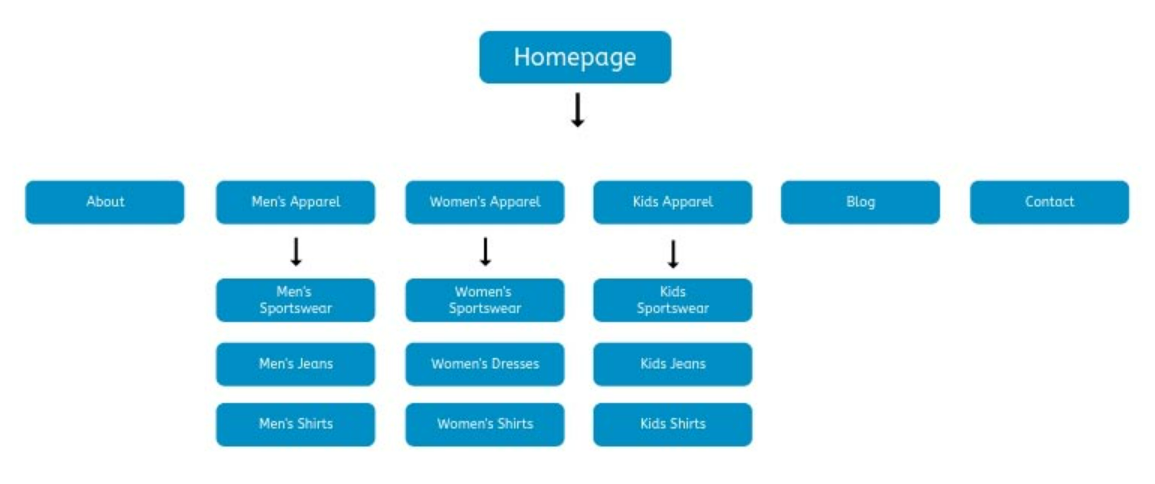
Hierarchy features to keep in mind:
- Balanced number of subcategories per category
- With minimal category numbers
- Logical
Search engines also use website hierarchy to learn the importance of pages. This will then determine the pages’ rank on SERPS. It’s always best to have your main product pages outrank your lower-level products and services.
4. Drive out the website navigation
Another crucial factor in the structure of your website is navigation. Also, it’s one of the biggest factors that can affect every user’s experience. Easy and good navigation can make obtaining leads more convenient and faster.
Having top-level navigation on the menu is necessary. It doesn’t matter how complicated the website is; having a user-friendly and simple navigation bar just below the header is a good decision.
The best example for this is Etsy:
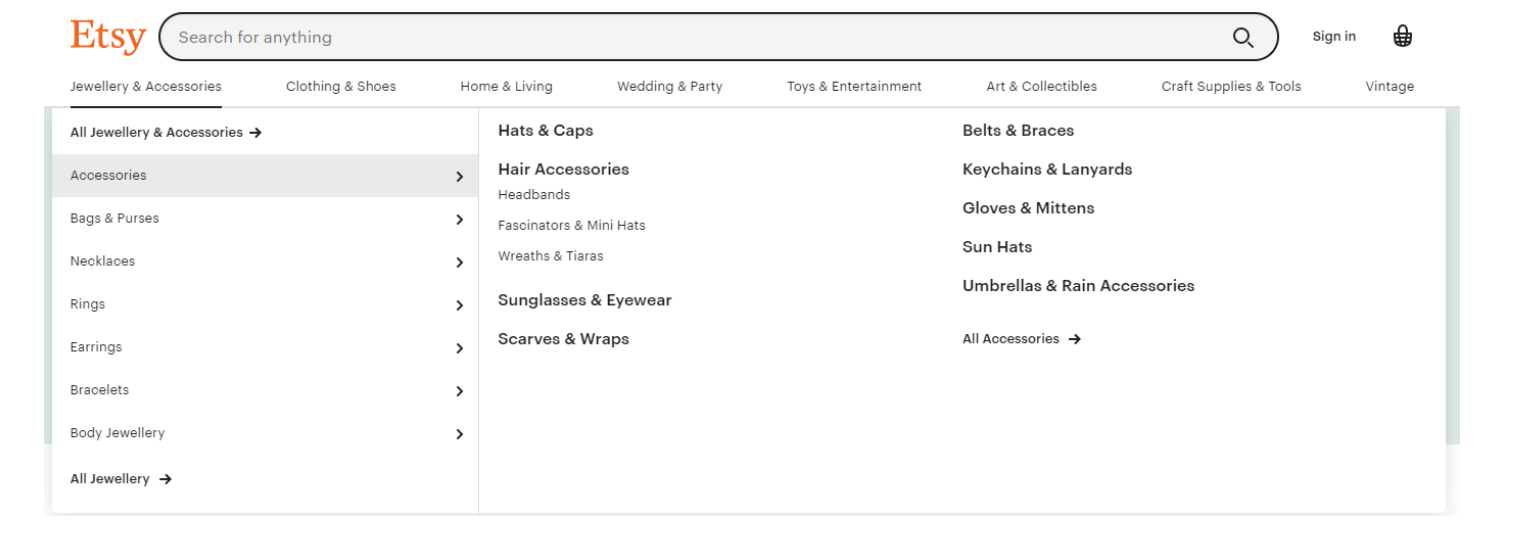
Source: Etsy
Several companies and web developers often make mistakes in creating unnecessary pages that need to be cleared out.
Keep it simple when creating navigation to the main profit-driving and inquiry sections. The users must easily search for the prices and its product features. A good place to put this information is on the same page but in the lower sections. If not, you can add a new subpage for this.
The search engine crawlers will have a more difficult time determining priority and navigating through you if the website’s navigation is filled with unnecessary links. This is a mistake that can instantly influence your search rankings.
Other e-commerce websites use filters as faceted navigation.
5. Utilize breadcrumbs
Breadcrumbs as navigation aren’t often given importance. These are trails of navigations displayed below the header, helping users to search around your website easily.
A breadcrumbs example is “All categories > Accessories > Hair accessories > Wreaths and tiaras.”

Source: Etsy
In addition, breadcrumbs make you think logically and start creating a clean and SEO-focused website instead of a messy website. The best part is, this helps the users have a better experience.
Having your website structure refined can help improve search engines to display the correct site links.
6. Prioritize user experience and security
All users and search engines prioritize security. Google prioritizes websites that ve HTTPS protocols. Several users are knowledgeable about looking at HTTPS at the URLs. This means they can evade malicious sites and avoid potential scams. So, ensure to use HTTPS on your website.
You should also create a website structure where the users can easily navigate to their desired pages in just a few clicks.
After all that, it is important to keep your consistency throughout your website and create similar structures to other pages and the ones next to it.
When just starting in this field, you can begin by using the top creators in your industry as your inspiration. After that, you can customize your layout and navigation to increase your familiarity with potential users.
7. Create comprehensive internal linking structures
Utilizing internal linking is very important for the hierarchy of a logical site. Here are the reasons why they are important to the users:
- Hierarchy information establishment
- Link juice spread on the sites
- Easy navigation
In addition, creating strategies for intensive internal linking can help boost SEO. The search engine crawlers will keep flowing from every page.
Creating several links on your content and web pages can help Google better understand your website to boost your rankings. Also, consider including descriptive anchor texts.
Lastly, internal links let users go from one page to another and land on related services and products. The longer they stay on your website, the better the chances of being your leads.
Knowing the SEO Basics is Your Website Structure’s Key to Success
Creating a website structure is crucial for the user’s experience and SEO. Search engineers can better understand your relevant page’s links and websites by having a strong SEO structure, and users will enjoy your site more.
The most appropriate time to create a solid site structure is just before finalizing your website. If your website just needs redesigning, you can modify the designs and rework the navigational elements to enhance structural SEO.
Click HERE to know more about other services and information that can help your desired website output and reach your SEO goals.
Let me know in the comment section if you use SEO or other marketing strategies!
Find this article informative? Read more to expand your knowledge on creating your website:
- 4 Easy Steps to Get YOUR Website To The Top of Google in 2020
- 11 Simple On-Page SEO Tips to Rank First on Google
- How To Improve Your Ranking With An SEO Checklist
How site structure for SEO works in AI search engines (ChatGPT, Perplexity, Google AI Overviews, Claude)
AI engines evaluate topical authority partly through site structure — a site with a tight cluster of internally-linked pages on a topic reads as authoritative on that topic in a way that a sprawling site with one-off coverage doesn’t. The hub-and-spoke pattern (one pillar page + 6-15 supporting posts, all cross-linked) is the structure that wins AI-engine citations consistently.
Practical 2026 site-structure moves: identify your top 5 topical clusters, designate a pillar page for each, ensure every pillar has 6-15 supporting posts internally linked, and make sure the pillar links back to each supporter. That single structural pattern moves both Google rankings and AI-engine citations simultaneously.
The 4-block GEO scaffold for site structure for SEO
- Lead with a TL;DR. 2-4 sentences at the top of the post that answer the head query directly. AI Overviews and Perplexity preferentially cite this block.
- Add a numbered step-by-step section. Generative engines extract clean ordered lists into their answers more reliably than prose.
- Close with an FAQ. Use the literal phrasing of questions people actually ask in your niche; mark up with FAQPage schema.
- Cite primary sources. Link to Google’s own AI Overviews documentation, OpenAI’s structured-data guidance, and Anthropic’s content-quality posts. LLMs trust pages that cite the model providers themselves.
Internal reading on AI SEO + GEO
If you’re building this into your stack, also read: the full SEO guide for 2026, What is SEO?, the programmatic SEO guide, 11 on-page SEO tips.
FAQ — site structure for SEO in the AI search era
How many internal links should a pillar page have in 2026?
10-30 outbound to supporting posts in the cluster, 5-15 inbound from supporting posts pointing back. Don’t force links — every link should make sense in context.
Does site depth still matter for SEO in 2026?
Yes — pages 4+ clicks from the homepage get less crawl attention from both Google and AI-engine bots. Keep important pages within 3 clicks where possible.
Should I restructure existing site architecture for AI search?
If your current structure is messy, yes — the AI-search lift is real. If it’s already clean and topically-clustered, no further restructuring is needed; just add the structural overlay (TL;DR + FAQ + schema) to the pillar posts.
Where I’d take this next
If you operate inside any of the loops above, I build custom AI agent systems that automate them. The whole site you’re reading is one — here’s the stack.
What changed in 2026
SEO in 2026 is unrecognizable from the 2020-era playbook. Three shifts that matter for anything written before mid-2024:
- AI Overviews are the new SERP zero position. Google’s AI Overviews default to roughly 60% of US informational queries, eating most “what is” / “how to” CTR. Optimizing for citation inside the AI Overview is now as important as ranking #1.
- GEO (Generative Engine Optimization) is the working term for cross-engine optimization — getting cited inside ChatGPT, Perplexity, Claude, and Gemini answers. ~12% of high-intent commercial queries in late 2025 sample studies showed a direct-citation flow from these engines (vs. zero pre-2023).
- E-E-A-T (now E^3-A-T, Experience + Expertise + Establishment + Authoritativeness + Trustworthiness) continues to be the framing Google uses internally — “Establishment” was the 2024 addition emphasizing brand-level signals.
Tool landscape (2026): Ahrefs and Semrush both shipped Generative Engine tracking. Surfer SEO + the Topical Authority crowd added GEO scoring. Screaming Frog still the standard crawler. AlsoAsked, Keyword Insights, and Frase shifted heavily into AI-Overview snippet engineering.
If this post predates May 2024, treat its core advice as the Google-search baseline and layer the GEO playbook on top.
Every Wednesday. 28,400+ operators. Zero fluff.
✓ Check your inbox — click the confirmation link to complete sign-up.
✓ You're subscribed!
✓ You're already on the list.
Related posts
Why Your Best-Ranking Pages Get Zero Clicks
I pulled my own Search Console data and found a page ranking position 8.9 with a 0.07% CTR. Here's what was actually wrong, and how I'd fix it.
GEOGEO for Multilingual Sites: Getting Cited in Every Language
Running GEO on a site that publishes in 13 languages taught me hreflang, llms.txt, and schema all behave differently than English-only advice assumes.
GEOHow to Add GEO to an Existing SEO Retainer
How an SEO agency adds real GEO work to an existing retainer — audit first, price it as its own line, and avoid relabeling the same deliverables.
Get the AI playbook in your inbox
Every Wednesday. 28,400+ operators. Zero fluff.
Check your inbox.
We sent you a confirmation email — click the link inside to complete your subscription. Check spam if you don't see it within a minute.
You're subscribed.
Welcome — the next edition lands in your inbox soon.
You're already on the list — look for it every Wednesday.